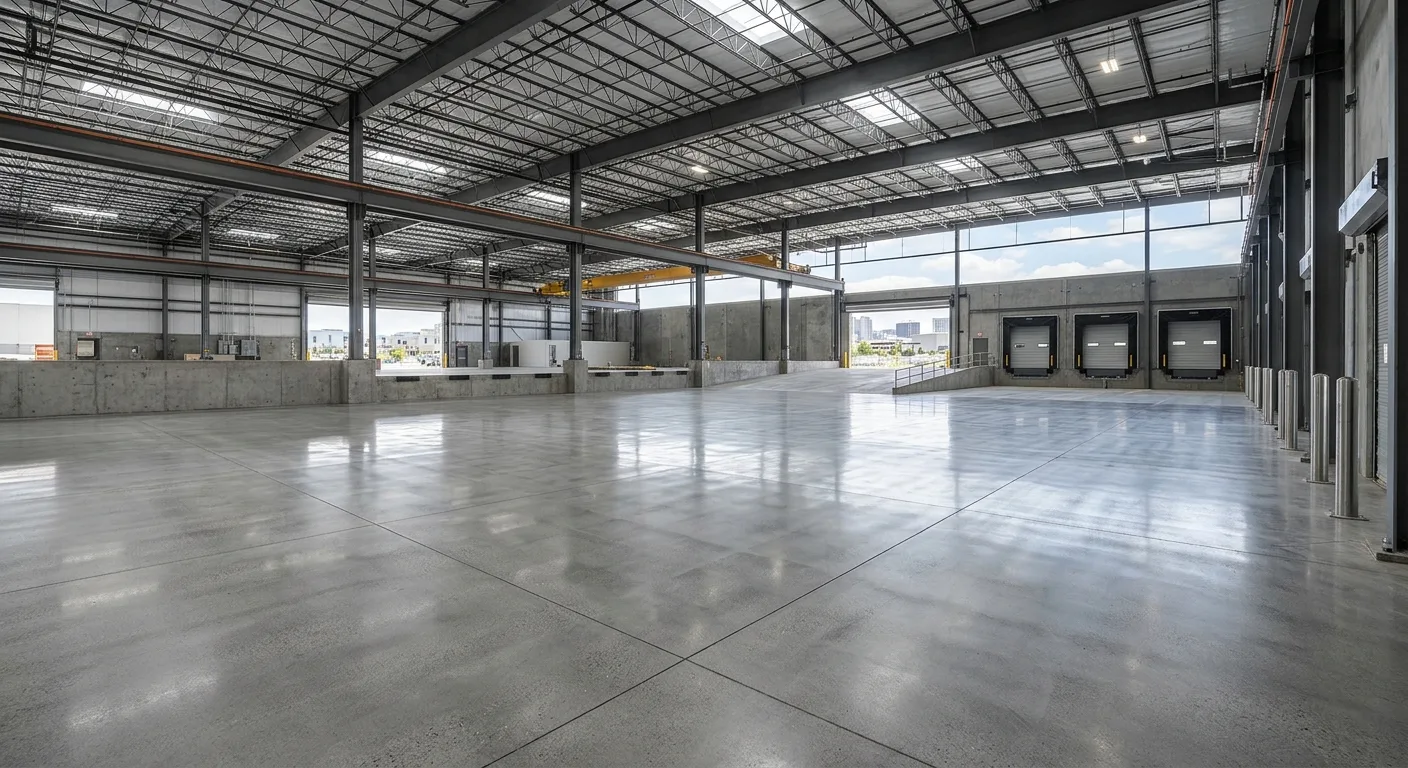
Structural Slabs and Foundations
Ground slabs, grade beams, and foundations sized for industrial occupancy loads. Reinforcement and pour schedules coordinated with structural drawings and city inspection.
Family-owned · San Jose Local
Heavy slabs, equipment pads, and structural concrete for industrial facilities throughout Silicon Valley.
Request an estimate
Overview
NDM Construction Inc handles industrial concrete contracting in San Jose and across Santa Clara County. Warehouse floors, loading docks, equipment pads, structural slabs, retaining walls. If it carries heavy loads or has to meet industrial code, that's the work. Jose Hernandez and the crew hold a California contractor license and have earned a 4.9-star rating across 10 Google reviews. Call (408) 608-9319 to talk through your project scope.
Industrial concrete is different from residential or retail flatwork. Slabs in manufacturing and warehouse environments have to account for forklift axle loads, point loads from racking systems, and in some cases chemical exposure from spills or wash-down operations. Bay Area soil conditions, particularly the expansive clays common in the South Bay, require proper sub-base compaction and, depending on seismic zone and occupancy class, reinforcement specs that go well beyond standard commercial minimums. San Jose sits in a high seismic hazard zone, so structural concrete work on industrial sites has to meet CBC Chapter 19 requirements and typically triggers city plan review before a permit issues. We coordinate that process. Cost on industrial concrete jobs varies widely based on slab thickness, reinforcement schedule, finish type, site access, and whether demolition of existing concrete is part of the scope. Every job is different. Contact NDM Construction Inc for an accurate estimate.
From ground-up slabs to repair work on occupied facilities.
Ground slabs, grade beams, and foundations sized for industrial occupancy loads. Reinforcement and pour schedules coordinated with structural drawings and city inspection.
Isolated pads for CNC equipment, compressors, generators, and heavy machinery. Thickness and mix design matched to point load requirements.
Dock aprons, approach slabs, and truck courts in mixes rated for repeated heavy axle traffic. Proper joint placement to control cracking under cycle loads.
Spall repair, joint repair, and partial-depth slab replacement. Work is sequenced so your facility stays operational through the repair process.
Cast-in-place retaining walls and site curbing as part of broader industrial site development or standalone grading and drainage work.
Saw-cutting and removal of existing concrete to make way for new construction or utility work, with debris hauled off-site.
How It Works
Industrial concrete projects move through three defined phases. Knowing what happens at each one keeps your timeline and your permit process on track.
Step 01
We review soil reports, structural drawings, and occupancy requirements. For work that triggers San Jose plan review, we coordinate the submittal and manage the inspection schedule through Santa Clara County building.
Step 02
Sub-base compaction, form work, reinforcement placement, and concrete pour are sequenced to hit spec. Mix design, slump, and air content are verified at the truck before placement starts.
Step 03
Industrial floors get the finish type the use demands: hard-trowel for warehouse floors, broom finish for exterior pads, or exposed aggregate where traction is the priority. Proper cure time is non-negotiable on industrial slabs.
What Sets Industrial Work Apart
Forklift axle loads, racking point loads, and vehicle traffic require a defined slab thickness and reinforcement schedule, not a rule-of-thumb number borrowed from a residential job.
San Jose sits in Seismic Design Category D. Structural concrete in industrial buildings has to meet ACI 318 Chapter 18 requirements, which affect reinforcement detailing and concrete strength minimums.
Facilities with oil, solvents, acids, or wash-down chemicals need concrete with the right w/c ratio and potentially a chemical-resistant topping. Standard mix design won't hold up.
Control joints, construction joints, and isolation joints on an industrial slab have to be laid out with traffic patterns and load zones in mind. Bad joint placement is the most common reason industrial floors crack early.
San Jose building department review for industrial concrete, especially when tied to structural or foundation work, typically runs 4 to 10 weeks depending on project complexity and current backlog. Plan for it.
Expansive clays are common across the South Bay. A proper geotechnical report and compacted aggregate base aren't optional on industrial sites, they're what keeps a slab flat five years in.
Standard concrete reaches design strength at 28 days. Heavy forklift traffic or racking installation before that point can cause damage that shows up later as cracking and joint deterioration.
NDM Construction Inc, licensed in California, serving San Jose and Silicon Valley.
Service area
NDM Construction Inc takes industrial and commercial concrete work throughout the South Bay and Silicon Valley corridor, from San Jose through Santa Clara and Milpitas to Morgan Hill. If your facility is in Santa Clara County, call and ask.
Good to know
Still have a question?
Call and talk it through. You'll get a straight answer from the person doing the work.
(408) 608-9319Call NDM Construction Inc at (408) 608-9319 or use the contact form to describe your project. We serve San Jose and all of Santa Clara County.
Next step
Your name, your number and what needs doing. A person from NDM Construction Inc gets back to you.
Rather talk now?(408) 608-9319